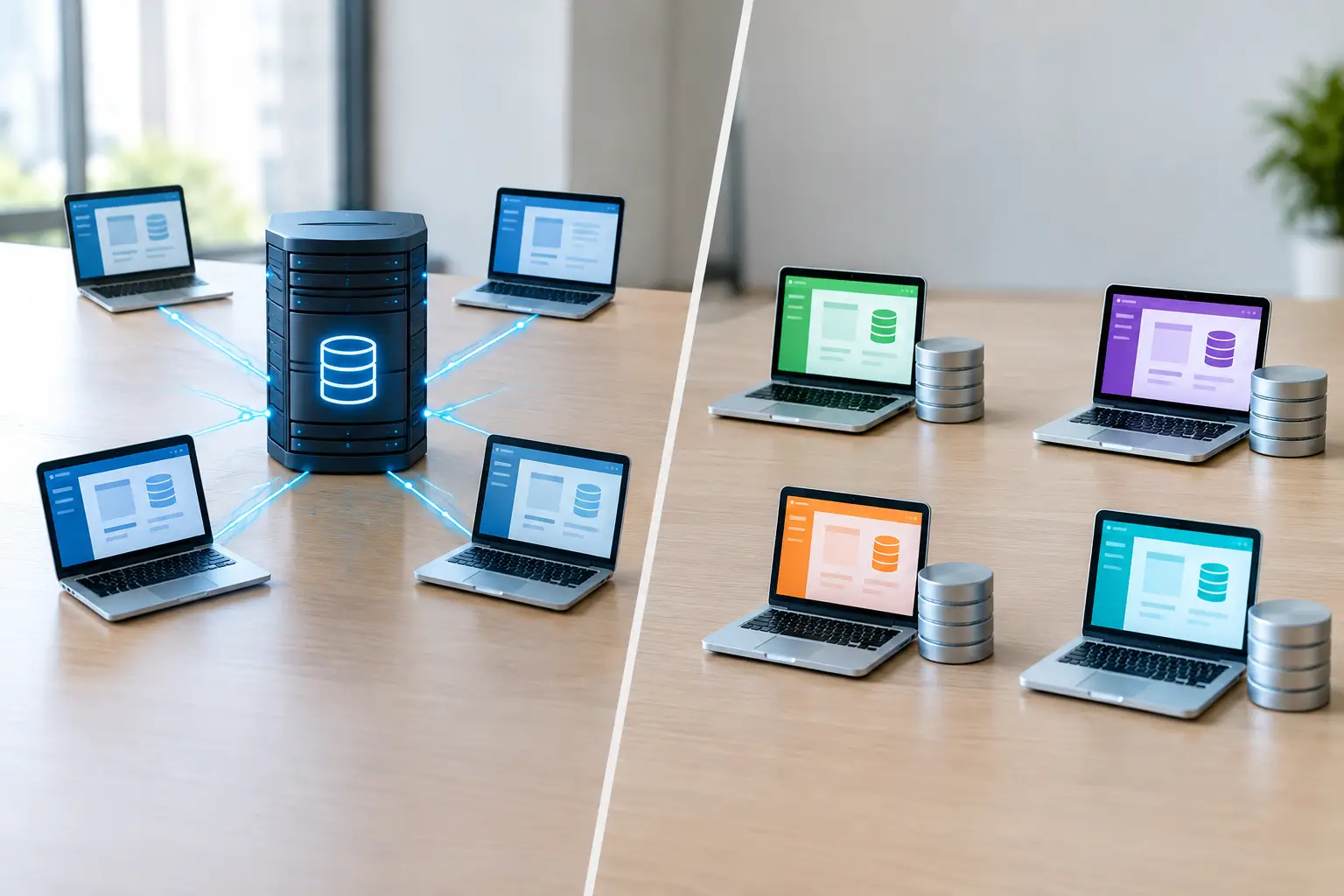
A trade is completed, cash is received at a branch, crypto is moved from a wallet, and a customer balance changes. If each event lands in a different tool, the finance team has to reconstruct the business after the fact. That is the operational difference between centralized ledgers versus separate systems: one creates a current financial record, while the other creates a daily investigation.
For crypto and multi-asset exchange operators, this is not a software preference. It affects whether teams can close the day with confidence, identify an exposure before it grows, and produce records that hold up under review. The right model depends on the complexity of your operation, but disconnected accounting rarely stays manageable as transaction volume, locations, assets, and staff permissions increase.
What Separate Systems Actually Cost an Exchange
Separate systems usually emerge for understandable reasons. A startup may use a spreadsheet for daily cash, an exchange platform for trade history, a wallet tool for crypto movements, bank portals for fiat balances, and generic accounting software for formal books. Each tool may work well in isolation.
The problem appears at the handoffs. A cashier records a cash transaction in one place. An accountant later posts a journal entry elsewhere. Operations tracks a transfer in a third system. When values, timestamps, counterparty names, or asset quantities do not align, someone must determine which record is correct.
That work is more than administrative overhead. It slows daily reconciliation and makes real-time P&L difficult to trust. Finance leaders may receive a revenue report that excludes a late adjustment, while branch managers act on a cash position that has already changed. The business is operating with several partial versions of the truth.
Separate systems also weaken accountability. When a discrepancy appears, teams can spend hours tracing whether it originated at the point of entry, during a spreadsheet export, in a manual journal, or through a delayed sync. The root issue is not necessarily staff performance. It is an operating model that relies on manual coordination to maintain financial accuracy.
Centralized Ledgers Versus Separate Systems: The Control Difference
A centralized ledger brings trade activity, asset movements, customer and counterparty balances, cash operations, bank activity, and accounting entries into one controlled record. Every operational event should feed the same financial structure, using defined rules rather than repeated manual interpretation.
For an exchange, centralized does not simply mean placing reports on one dashboard. It means the underlying accounting logic is connected. If an operator records a crypto sale for cash, the platform should reflect the change in asset inventory, customer or counterparty position, cash balance, revenue, and applicable fees according to the configured double-entry rules.
This structure changes the daily rhythm of the finance function. Reconciliation becomes a verification process instead of a data-collection exercise. Teams can compare physical cash, bank balances, wallets, and ledger positions against a common source of record. Exceptions still happen, especially in a business handling multiple assets and settlement methods, but they become visible sooner and are easier to assign.
The distinction is particularly valuable when an operation manages crypto alongside fiat, gold, or oil. Separate systems often force each asset class into its own reporting workflow. A centralized accounting OS can preserve asset-level visibility while giving leadership one view of the business. That means a manager can examine a specific branch's cash exposure without losing sight of overall holdings, trading performance, and liabilities.
Real-Time P&L Requires Complete Inputs
Many exchange operators can generate a profit and loss report. Fewer can rely on it during the operating day.
A P&L is only as current as the transactions and adjustments that feed it. When trading data, conversion rates, operating expenses, fee income, and inventory movements sit in separate systems, reporting becomes dependent on imports and cutoffs. The report may be technically correct for a past moment while being operationally stale.
A centralized ledger reduces that gap by recording activity as it happens. Finance leaders can monitor revenue, fees, asset positions, and branch performance with fewer manual consolidations. This does not eliminate the need for financial review or period-end controls. It does give decision-makers a more reliable view between closes.
That matters when margins are tight or market conditions move quickly. A delayed view of inventory cost, wallet balances, or outstanding customer obligations can create decisions based on assumptions rather than recorded facts. Centralization gives teams a stronger starting point for action because the numbers are tied to the same transactions the business is processing.
Better Permissions Reduce Operational Risk
A common misconception is that centralization gives too many people access to too much information. The opposite should be true when the platform is designed for financial operations.
In a centralized system, role-based access control can define what each person is allowed to view, create, approve, edit, or export. A cashier can record authorized activity without gaining access to enterprise-wide P&L. A branch manager can review location performance without changing accounting rules. An accountant can investigate exceptions with an audit trail that shows who performed each action and when.
With separate systems, permissions are often inconsistent. One tool may have detailed controls, while another relies on shared logins or broad spreadsheet access. Data is then copied into email attachments, local files, and personal folders to bridge the gaps. Every copy expands the security and version-control problem.
Centralizing financial records also supports cleaner approval workflows. High-value adjustments, transfers, or account changes can be reviewed through a defined process rather than handled through informal messages. For owners and finance leaders, this creates a practical separation between daily execution and financial oversight.
When Separate Systems Can Still Make Sense
Centralization is not automatically the right first move for every business. A very early-stage exchange with limited transaction volume, one asset type, one location, and a small number of operators may be able to run temporarily on specialized tools and disciplined manual controls. The key word is temporarily.
Separate systems can also remain appropriate when a business needs a specialized external platform for a narrow function, such as custody, payments, or compliance screening. Centralization does not require replacing every operational technology. It requires ensuring that financially relevant events are captured consistently in the core ledger and can be reconciled without unreliable workarounds.
The warning sign is not the number of tools alone. It is the amount of manual effort needed to explain the relationship between them. If month-end depends on exporting files, cleaning columns, matching transactions by hand, and posting catch-up journals, the business has outgrown its current structure.
What to Look for in a Centralized Accounting Platform
Exchange operators should assess a centralized system based on operational fit, not only on general accounting features. The platform must support the assets you actually handle, whether that includes cryptocurrency, cash, bank-based fiat, precious metals, or commodities. It should also preserve a clear record of the transaction lifecycle, from initial activity through reconciliation and reporting.
Automated double-entry accounting is essential because it reduces the risk that operational actions and formal books drift apart. Real-time reporting matters because delayed visibility defeats much of the purpose of centralizing records. Role-based permissions, user activity monitoring, and audit-ready transaction history are equally important for organizations handling sensitive financial data across teams and branches.
Implementation should be practical as well. A platform that requires months of data reformatting can delay the control improvements you need now. Siferex is built specifically for crypto and multi-asset exchanges, with a four-step migration workflow, unlimited users, and a single $3,000 annual subscription rather than per-seat pricing or feature tiers.
Bank-grade infrastructure and dependable cloud access are not optional details. If the accounting platform is the financial operating record, availability and security become direct business requirements. Teams need confidence that authorized users can access current records while sensitive data remains protected.
The most useful next step is to map one complete operating day: every trade, deposit, withdrawal, wallet transfer, cash movement, adjustment, and approval. If your team cannot follow each event into a single reconciled ledger without exporting data or asking which spreadsheet is current, the opportunity is clear. Build the control layer before growth makes the gaps more expensive.